Posted by Diane Heiserman on Tue, Apr 09, 2013 @ 06:00 AM
Submitted by Dave Schiver, Airframe Tech Rep
On March 27th, the FAA issued two Notices of Proposed Rulemaking (NPRM) for Learjet 60 and Learjet 40/45. Continue reading for details.
Learjet 60
The FAA has proposed an upcoming Airworthiness Directive (AD) for Squat Switch & Anti-Skid Shielding on certain model Learjet 60 aircraft. You are encouraged to read the details of and comment about the proposed AD during the open commenting period which ends on May 13, 2013. Details of the Notice of Proposed Rulemaking can be found here.
Required Service Bulletins
This proposed AD will require the installation of the following Service Bulletins (SB): SB60-32-33 & SB60-57-7. These SBs install the metal shielding around the Main Landing Gear (MLG) Squat Switches & MLG Anti-Skid Valves to protect them in case of an accidental impact.
Terminating AD 2010-11-11
The above SBs are two of the four required SBs to terminate AD 2010-11-11. This AD is the 96-Hour Tire Pressure check, per the FAA Alternate Method Of Compliance (AMOC) Letter L115W-12-459. The other required SBs are SB60-27-6, Wheel Speed Detect Box, and SB60-78-7, Thrust Reverser (TR) Interface Box.
Another requirement called out in the AMOC is for the Temporary Flight Manual Change (TFM) 2012-03 to be inserted in the Airplane Flight Manual (AFM). Bombardier first published this information in AW32-061 on July 30, 2012.
SB60-78-7
As a side note, in order to comply with SB60-78-7, the Wheel Speed Detect Box, if previously installed, may need to be exchanged in order to be upgraded for compatibility with the TR Interface Box.
Learjet 40/45
The FAA has proposed an upcoming AD for the Baggage Door Fire Seal of certain model Learjet 40/45 aircraft. You are encouraged to read the details of and comment about the proposed AD during the open commenting period which ends on May 13, 2013. Details of the Notice of Proposed Rulemaking (NPRM) can be read here.
Required Service Bulletins
The proposed AD requires the installation of SB40-25-25, Revision 3, or SB40-25-25, Revision 3, within 300 flight hours after the effective date of the AD. These SBs call for the modification of the fire seal on the baggage door, including doing general visual inspections of the fire seal for correct contact.
Exceptions
If Revision 1 or 2 of SBs SB40-25-25 / SB45-25-35 have been complied with prior to the effective date of this proposed AD, no further action is required.
All of Duncan Aviation's full-service locations are Authorized Learjet Service Centers, and are able to provide comprehensive Learjet airframe services, inspections and technical support for all models.
Dave Schiver is an Airframe Technical Representative at Duncan Aviation’s Lincoln, Nebr. (LNK) facility. He specializes in Learjet aircraft. His aviation career began in 1981.
For more updates from Duncan Aviation, please follow us on Twitter and become a fan on Facebook.
Posted by Diane Heiserman on Tue, Oct 09, 2012 @ 03:50 PM
Contributed by Gary Harpster, Avionics Sales Rep

My best advice to you, as an operator, is to start now and ask questions and continue to ask questions until you understand. Then ask more.
There is so much information available to customers who are beginning their research on FANS-1A solutions. Your best approach when beginning your FANS-1A research is to ask a lot of questions. But don’t be surprised if your questions create more. Break out a pen; it’s time to start taking some notes.
Below is an experience I had with a recent customer while discussing a FANS-1A solution for his aircraft. We began to discuss the need for very precise aircraft position information. I told him the least expensive path would be to install WAAS receivers, as they have the level of accuracy needed to accomplish a FANS-1/A solution.
Customer Question #1 - FMS
“OK. So new FMSs will get me to a FANS-1/A solution?”
No, not exactly. You’ll still need a means of sending and receiving text data from the cockpit to the airspace controlling agency, so you will need some sort of data link system besides the Flight Management Systems.
Customer Question #2 – Data Link Systems
“OK. So, if I get new FMSs and a Data Link System, then I’ll be FANS-1/A compliant?”
Not just yet. You see, since all voice information is being captured by the cockpit voice recorder now and you’re going to start texting, you will need a different cockpit voice recorder (CVR) than what you have now that can capture text data.
Customer Question #3 - CVR
“I think I’ve got it! A new CVR, Data Link and Flight Management Systems, will get me FANS-1A solution.”
Well I’m afraid not, at least not yet. Even though you have the accuracy, the means of capturing the data and generating text data, you still need to send it and receive it and, since you are too far away from land for a VHF signal, you are going to have to rely on Satellite Communications. If you are looking for the most cost effective means, I’d suggest using an Iridium Transceiver.
Customer Question #4 – FANs-1A Effective Date
“I had no idea all of this was needed. When does this take effect again? 2015?”
In 2015 is when VHF Datalink (VDL) Mode 2 begins. However, the regulatory authority over the Atlantic is International Civil Aviation Organization (ICAO), and they are saying no one, who is not FANS-1A compliant, will be allowed to fly within the North Atlantic Tracks between the altitudes of FL370 to FL390 beginning in February of 2013.
Customer Question #5 – Installation Qualifications
“2013! That’s less than five months away! Where can I get this system installed?”
That’s a potential challenge too. Any MROs who have the capability to install the system on your aircraft, are also required to have a Supplemental Type Certificate (STC) for the entire solution, including all of the components. There currently isn’t much out there being offered, in the way of a full solution. Even if there was, you are still required to get a new Letter of Authorization (LOA), which could take months to get approved by your local Flight Standard District Office (FSDO), especially since their work load is so high right now.
Customer Question #6 – Is that it?
“You mentioned VDL Mode 2 in 2015? What does that mean?”
Many operators were told that if they put in this initial solution, the one we just talked about, that when 2015 rolls around and Europe is begin requiring VDL Mode 2, that they would be exempt from having upgrade because they complied early to the first portion. That sounds good, but sometimes you have to ask what it really means to be exempt?
In this case, it means that 75 percent of the aircraft operating in Europe will already be complaint, so the remaining 25% will be managed into the airspaces when they can be, with priority being given to aircraft that are already compliant.
Ask Questions Until You Understand, Then Ask More
Because each aircraft requires a unique solution, all systems require a fresh approach. My best advice to you, as an operator, is to start now and ask questions and continue to ask questions until you understand. Then ask more. There is so much information out about the FANs-1/A topic, but so much is still unknown. I’m afraid that we’ve only scratched the surface.
At Duncan Aviation, we consider ourselves to be on the cutting edge of all avionics technology, and the subject of FANS-1/A is no different. We have done ample research and talked with hundreds of our customers to develop the most valuable information we can provide. To learn the latest about FANS-1/A, download the Straight Talk about FANS booklet. Watch for information coming soon about an upcoming FANS video series and webinar, created by Duncan Aviation FANS experts.
Gary Harpster serves as an Avionics Installations Sales Rep. at Duncan Aviation's full-service facility in Lincoln, Neb. (LNK), specializing in Hawkers and Learjets. He is an industry expert on NextGen initiatives, giving presentations across the U.S. Gary is currently serving as Vice-Chair of the AEA board of advisors. He began his career in aviation in 1977.

For more updates from Duncan Aviation, please follow us on Twitter and become a fan on Facebook.
Posted by Diane Heiserman on Wed, Jul 25, 2012 @ 02:53 PM
Contributed by Jeff King, Chief Inspector - Components/Satellites
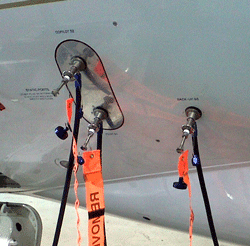
Duncan Aviation technicians hook up the RVSM test-set to the right-side static ports to test the copilot's RVSM system.
Though nearly every general aviation aircraft has received RVSM certification, maintaining that certification has become a cloudy process for operators. With the new Height Monitoring Requirements now a reality, operators continue to have questions. Here is a recent question from a Directory Maintenance about long-term RVSM monitoring.
What if my aircraft has the factory RVSM STC, do I still have to have the flight check every two years?
The answer is yes. No matter how the RVSM solution was installed on your aircraft, you are still required to meet the Height Monitoring requirement.
The guidance says every two years or 1000 flight hours, whichever is greatest. So if you fly less than the 1,000 hours in the two year period, you can continue to meet the height monitoring requirement until you reach the 1,000 hour limit.
Meeting Height Monitoring Requirements
Height Monitoring Requirements are easily met if your aircraft is equipped with Mode S transponders. With Mode C transponders you will need to have a qualified technician come on board and perform the monitoring.
For more information, read the regulatory Requirements for RVSM Maintenance Intelligence article, or download the Straight Talk About RVSM booklet.
Jeff King is the Chief Inspector of Duncan Aviation's Component Solutions and Avionics Satellite Network. He specializes in FAA regulatory compliance for repair stations and aircraft maintenance professionals. His aviation career began in 1987.
For more updates from Duncan Aviation, please follow us on Twitter and become a fan on Facebook.
Posted by Diane Heiserman on Thu, May 17, 2012 @ 03:27 PM
Contributed by Cliff Barker, Flammability Engineer

In 1984 the FAA increased its flammability requirements beginning with the materials used for cabin seat cushions.
From 1981 - 1983, there were 277 transport category aircraft accidents in the United States. Of all the accidents that involved a post-crash fire, 34 were determined to be SURVIVABLE, yet nearly 600 passengers still suffered fatal injuries. In an effort to reduce the hazardous risks to passengers and crew aboard an aircraft during a SURVIVABLE accident, in 1984 the FAA began requiring certain materials used within the interior an aircraft to pass more stringent flammability requirements beginning with the materials used for seat cushions.
Today, all materials used in major repairs and alternation of an aircraft must past a series of FAA-approved flammability tests to be cleared for use. Although minor repairs/alterations do not require FAA approved test data, testing must still be provided to show that the proper testing was conducted for the material “As Installed” and that the results of these test are within their passing criteria
As a part Duncan Intelligence LIVE held May 23 in Battle Creek, MI, I will be leading an Inspector Authorization (IA) course on Flammability Testing that covers the FAA’s Flammability Regulations and how they are applied throughout the aircraft.
Duncan Intelligence LIVE
Duncan Intelligence LIVE is a free educational business aviation seminar, hosted by Duncan Aviation's Regional Managers. It is a face-to-face forum discussion with industry experts on hot industry topics as well as courses with Inspector Authorization (IA) renewal credit.
There is no cost for the event or meals and seating is limited. Come early the day before and enjoy an evening of golf and food. Click here to view all the course offerings and register for the event.
Cliff Barker is a Flammability Engineer at Duncan Aviation’sBattle Creek,MI, facility. He specializes in FAA Flammability Regulations. His aviation career began in 1978.
For more updates from Duncan Aviation, please follow us on Twitter and become a fan on Facebook.
Posted by Diane Heiserman on Thu, Dec 15, 2011 @ 11:59 AM
Contributed by James L. Ferguson, ODA PMA Administrator

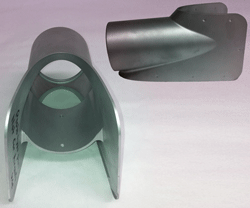
Max Viz Camera pod machined from a solid piece of aluminum with no welds. Designed, modeled and fabricated in-house, this part was completed in approximately 8 hours. Duncan is currently researching the viability of PMA approving this part.
Aircraft service providers that hold aircraft Parts Manufacturer Approval (PMA) authority under ODA have a significant advantage in FAA approval response times. These service providers are able to respond almost immediately to any issues in the application and/or certification of new PMA parts. However, the pathway to PMA authority isn’t easy.
Duncan Aviation recently received approval through the FAA’s Wichita Aircraft Certification Office (ACO) to add PMA to its revised Organizational Designated Authority (ODA). FAA order 8100.15 details the many steps we navigated through to prove we had the capabilities, processes and aviation professionals in place even to be considered.
PMA aircraft parts applicants must qualify, make application and be granted this approval by the FAA Organizational Management Team (OMT).
Qualification
In order to be considered for PMA aircraft parts authority under ODA, applicants must already hold PMA authority through their local Manufacturing Inspection District Office (MIDO). At the time PMA authority is being considered under ODA, the PMA holder must show the FAA that they meet the required qualifications for delegation as identified in FAA Order 8100.15.
Application
An application is submitted by the ODA holder documenting how the requirements are met along with procedures on how the ODA PMA will function. These procedures are documented in the ODA Procedures manual.
Review Process
After application, the OMT reviews the history of the PMA parts applicant, qualifications and the procedures manual. The OMT includes the applicant’s local ACO, Flight Standards District Office (FSDO), MIDO and Aircraft Evaluation Group (AEG). All must give approval during review, which includes on-site visits as necessary.
Delegation
Once delegation is received, PMA becomes a part of the applicant’s ODA. There is usually very little impact to production since the procedures, experience, and training already in place for previous PMA delegation are still applicable. The most significant change comes in how new PMA supplements (granting authority to produce new articles under PMA) are added and the maintenance of current PMA supplements.
Under ODA PMA, delegates no longer submit application to the FAA for approval in the way that they did previously. The ODA on-site now reviews the applications for each supplement or supplement addition and grants approval. This is where the advantage in response time is realized.
PMA Response Times
Since the application and approval process is accomplished internally, in coordination with the FAA when applicable, Duncan Aviation is able to respond almost immediately to any issues in the application and/or certification of new PMA parts that may be vital to the maintenance of a customer’s aircraft. It makes the process much simpler and more easily managed.
Since 1981, Duncan Aviation has been manufacturing aircraft parts under its PMA authority with the FAA’s approval. In 2011, Duncan Aviation added ODA PMA authority.
For more information about aircraft parts manufacturing and other Duncan Aviation ODA services, contact Stacy Carnahan in ODA Engineering Sales.
James L. Ferguson is Duncan Aviation’s ODA PMA Administrator. He has been an Aviation Professional with Duncan Aviation since 1979.
For more updates from Duncan Aviation, please follow us on Twitter and become a fan on Facebook.
Posted by Diane Heiserman on Tue, Dec 13, 2011 @ 12:10 PM
Contributed by David Schiver, Airframe Tech Rep

When moving any aircraft across country boundaries, be aware of all the requirements determined by the destination country.
In recent months, Duncan Aviation has performed several pre-buy evaluations that have resulted in a Learjet being either imported into or exported out of the U.S. Unique challenges always present themselves with these types of requests.
If you consult the Type Certificate Data Sheet first, you will be able to overcome many of these issues.
ECR Requirements
On page 33 — note 13 of A10CE (currently at Rev 57), is a list of countries, models and Engineering Change Records (ECRs) that are required for exporting Learjets out of the U.S. Also noted are models that require ECRs to be unmodified in order to import Learjets back into the U.S.
On page 13 – note 10 of T00008WI (currently at Rev 13), are lists of JAA/ EASA and non-JAA/ EASA countries and their applicable ECRs required for each model.
ECR Compliance
If there is an ECR required to import or export your Learjet into or out of the U.S, there are other issues that you need to be aware of:
- Learjet has not sold these ECRs in the past.
- Learjet has not supported a Road Trip or Mobile Repair Party to comply with an ECR in the past.
- If there is an ECR involved, it must be complied with prior to importing or exporting your aircraft.
At this time, to comply with a necessary ECR, you are required to go to a Learjet-Owned Service Center.
Keep in mind, when moving aircraft across country boundaries, there are usually other requirements than those stated here. Those exact requirements are determined by the destination country.
David Schiver is an Airframe Tech Rep at Duncan Aviation's Lincoln, Nebr., facility. He specializes in troubleshooting technical issues with the Learjet airframe. His aviation career began in 1981.
For more updates from Duncan Aviation, please follow us on Twitter and become a fan on Facebook.
Posted by Diane Heiserman on Thu, Dec 08, 2011 @ 02:56 PM
Contributed by Gary Harpster, Avionics Sales Rep.
I recently asked a customer who logs many hours flying in international skies what he thought was most important when landing on foreign soil. His reply was simply, “make sure your SAFA manual is up to speed.” After a little bit of research and a quick Google search, I found the following link that does a good job explaining the EU Safety Assessment of Foreign Aircraft (SAFA) programme.
http://www.easa.eu.int/approvals-and-standardisation/safety-assessment-of-foreign-aircraft-SAFA.php
There are currently 42 member states engaged in the EC SAFA: Albania, Armenia, Austria, Azerbaijan, Belgium, Bosnia and Herzegovina, Bulgaria, Croatia, Cyprus, Czech Republic, Denmark, Estonia, Finland, France, Georgia, Germany, Greece, Hungary, Iceland, Ireland, Italy, Latvia, Lithuania, Luxembourg, Malta, Moldova, Monaco, Netherlands, Norway, Poland, Portugal, Republic of Georgia, Romania, Serbia, Slovakia, Slovenia, Spain, Sweden, Switzerland, The former Yugoslav Republic of Macedonia, Turkey, United Kingdom, Ukraine.
As you can see, there are a lot of participating countries and if you fly overseas, you will certainly fly in one or more of them. This makes knowing and understanding the SAFA requirements very important to you.
From a maintenance standpoint, SAFA clearly justifies why you need to keep your aircraft in proper compliance. Things like tire wear and hydraulic leaks are all part of the inspection criteria, as well as crew license, procedure manuals, safety equipment for cabin and cockpit, cargo carried on board and overall technical condition of the aircraft.
If your aircraft is dripping oil or any other fluids at a higher flow rate than what is called out in these guidelines, be prepared to have it fixed before you depart. However, the person fixing that leak needs to possess the proper credentials, in other words, SAFA-certified.
The SAFA inspectors have a list of 54 items that can be checked. If not in compliance, many could significantly delay or even ground of your business aircraft. SAFA inspectors are willing to work with you; using good communication goes a long way.
If you’re planning a trip abroad soon, I recommend you find out the correct procedures on writing your own SAFA manual and getting it approved.
Gary Harpster is an Avionics Sales Rep. located at Duncan Aviation's Lincoln, Neb., facility. He specializes in mandates, cockpit upgrades, new technology and high speed data solutions. Gary is currently serving as Vice Chairman of the AEA (Aircraft Electronics Association). His aviation career began in 1977.
Related article: SAFA Required ID Plates for N-Registered Business Aircraft
For more updates from Duncan Aviation, please follow us on Twitter and become a fan on Facebook.
Posted by Diane Heiserman on Thu, Dec 01, 2011 @ 03:26 PM
Contributed by Scott Shefke, Airframe Tech Rep.
An ID plate identifying the aircraft must be displayed in a pominent position near the main entrance.
SAFA ramp inspections are occurring more often to N-registered aircraft operating in EASA-controlled countries. The purpose of these inspections is to ensure aircraft are meeting minimum standards in several areas, such as emergency exit, altimeters, flight recorders, GPWS, ELT and electronic navigation data management. The list goes on and on. The complete list from for the SAFA Program can be found here: http://www.icao.int/FSIX/_library/coscapsea/ Reference_ANNEXES_for_
ICAO_Ramp_Inspections_Guidance_2009_07_02.pdf.
Identification Plate Requirement
On page seven (7) of the above document is a reference to a required Identification Plate that must be displayed in a prominent position aboard the aircraft. ID Plates are not required by the FAA in the United States, but if you plan to fly in EASA-controlled countries, be aware that you will need to have a plate installed or risk getting hit with a fine during a SAFA Inspection.
A8. Documents required to be carried on board - Identification Plate
“An aircraft shall carry an identification plate inscribed with at least its nationality or common mark and registration mark. The plate shall be made of fireproof metal or other fireproof material of suitable physical properties and shall be secured to the aircraft in a prominent position near the main entrance or, in the case of an unmanned free balloon, affixed conspicuously to the exterior of the payload.”
The reference gives direction as to the material the plate must be made from, but nothing is stated about the dimensions.
If you want to make your own plate, one OEM recommends cutting it to .98” x 3.94” from a .063” stainless steel sheet. Engrave the plate with .60” high lettering at an engraving depth of .04”. One operator said he went to his local trophy engraving shop and had them make a placard. He installed it in a prominent place using a two-part epoxy.
Scott Shefke is an Airframe Tech Rep. located at Duncan Aviation's Lincoln, Nebr., facility. He specializes in educating operators about and troubleshooting the Challenger and Global airframes. Scott currently services on Bombardier's Challenger 600 Series Advisory Board and Bombardier Industry Steering Committee. His aviation career began in 1991.
For more updates from Duncan Aviation, please follow us on Twitter and become a fan on Facebook.
Posted by Diane Heiserman on Thu, Jul 28, 2011 @ 01:27 PM
Contributed by Don Heinlein, Domestic & International Parts Team Leader

Proper documentation will get aircraft parts more easily approved by the U.S. Dept. of State to pass through U.S. Customs without delay.
Operators are sometimes unaware that parts or units listed on the United States Munitions List (military items) must meet specific requirements to be shipped to the U.S. Without proper authorization, shipments can be delayed at the border for months. Here’s what you need to know to avoid delays.
The United States Government has International Traffic in Arms Regulations (ITAR) pertaining to the import and export of parts or units on the United States Munitions List.
ITAR items shipped to theU.S.are not allowed into the country unless the company or person shipping the item (shipper) has registered with the U.S. Department of State (DOS) and has obtained an import license, or that the shipment qualifies for a license exemption.
If items are shipped to the U.S.without this prior-authorization, they maybe held at the border for up to 60 days while the DOS decides whether to approve their admittance into the U.S.
To prevent days and weeks of delays, I highly recommend you notify your U.S.aircraft parts service provider prior to shipping any aircraft parts for repairs or exchange cores. They should be able to identify if the part is ITAR controlled and provide the proper language required for the commercial shipping invoice.
If your chosen aviation parts service provider is not knowledgeable of U.S. ITAR, is not capable of pre-clearing your shipment or is not able to provide the necessary language and paperwork for your shipment to enter the U.S., stop and find one that is.
Duncan Aviation screens all incoming shipments for ITAR-controlled items and provides our broker with the proper information for U.S. Customs so the parts are easily approved by the DOS and pass through U.S. Customs without delay. We monitor all shipments as they go through this process and will swiftly deal with any delays in a timely manor.
To ship parts to Duncan Aviation, please complete a shipping notice form.
Duncan Aviation provides extensive repair and overhaul services—including loaners and exchanges—for business aircraft parts, avionics, instruments, accessories and propellers. We maintain a large inventory of aircraft parts for sale. We also hold more than 70 manufacturer authorizations for avionics, instruments, accessories and propeller units.
Don Heinlein serves as the Domestic & International Parts Team Leader at Duncan Aviation, specializing in parts requests. He began working in aviation in 1977.
For more updates from Duncan Aviation, please follow us on Twitter and become a fan on Facebook.
Posted by Diane Heiserman on Fri, Jul 15, 2011 @ 10:05 AM
Contributed by Mike Bernholtz, Turbine Engine Services Sales Rep.

Honeywell and Duncan Aviation encourage all TFE731 operators to take a "sooner" rather than "later" approach when complying with AD 2005-05-15.
December 31, 2011, is the last day to comply with the FAA Airworthy Directive (AD) 2005-05-15. This AD requires the replacement of low pressure turbine LPT stage 1 discs for affected TFE731-3, -3A, -3AR, -3R, -3B, and -3BR series engines.
Delayed Inspection May Mean Delayed Capacity & Parts
According to the Honeywell website, there has been a low compliance rate for this AD since it was issued in 2005. They are encouraging all operators who are affected to contact an authorized service center immediately to schedule the inspections and part replacements.
Consequently, at Duncan Aviation, we believe as the deadline gets closer, the demand and lead time for parts will increase significantly. There is also a real possibility that engine maintenance shops will not have the capacity to handle these requests on a 'last minute' basis.
Affected TFE731 Engines
All TFE731-3, -3A, -3AR, -3R, -3B, and -3BR engines installed on one of the following aircraft models must have this AD performed before 2012.
- Learjet 55
- Hawker 400, 600,700
- Westwind I and II (IAI 1124)
- Falcon 50
- Jetstar
- Astra
- Citation III/VI
- Sabreliner
This AD does not apply on engines that have had the 3C or 3D upgrade.
Engines that are still running a LPT1 disc part, numbers 3072070-All, 3072351-All, 3073013-All, 3073113-All, 3073497-All and 3074103-All, require replacement prior to 2012.
To further emphasize the importance of complying sooner rather than later, Honeywell has issued a Service Information Letter (SIL). If applicable, Honeywell has a pricing program for the replacement of the disc and the LPT1 blades.
Duncan Aviation is a Honeywell Authorized Service Center and operates a 20,000 square foot engine maintenance shop dedicated to the support of TFE731 engines.
For more information about this AD, contact Shane Heier, Duncan Aviation's Honeywell Engine Tech Rep. To schedule this inspection and parts replacement, contact Engine Maintenance Service Sales.
Mike Bernholtz is a Turbine Engine Services Sales Rep specializing in Honeywell TFE731 inspection and maintenance services. His aviation career began in 1989.
For more updates from Duncan Aviation, please follow us on Twitter and become a fan on Facebook.