
Posted by Diane Heiserman on Tue, Mar 19, 2013 @ 06:00 AM
Contributed by Gary Harpster, Avionics Service Sales Rep.

WAAS/LPV has no bearing on the IFR Requirements of adding fuel or designating an alternate airport in a flight plan.
There aren’t many days that go by where I don’t field a question or two or provide clarification about WAAS/LPV. I am happy to answer them all. The following is a question that I recently received.
Do I still have to add gas/alternate [airport] if I'm going somewhere that will be WAAS LPV only?
The quick answer is yes. Now for a more in depth look as to why.
Requirements for IFR Flight Conditions
The only reason a pilot is required to designate an alternate airport is when the forecasted weather at the intended destination is below minimums one hour before to one hour after the estimated arrival time. If these conditions are met and filing for an alternate airport is required, then additional fuel is also required. The aircraft must carry enough additional fuel to continue flying at normal cruising speed to the alternate airport and for an additional 45 minutes.
Weather minimums are:
Forecasted cloud ceiling is at least 2,000 feet above the destination airport and visibility will be at least three statute miles for at least one hour before and hour after the estimated time of arrival.
If you have any questions about WAAS, or any other avionics installation related question, please feel free to contact me or download the "Straight Talk About WAAS" booklet and "Upgrading to WAAS" guide.
Gary Harpster serves as an Avionics Installations Sales Rep. at Duncan Aviation's full-service facility in Lincoln, Neb. (LNK), specializing in Hawkers, Falcon 900, EZ2 Upgrades and Learjets. He has given WAAS presentations across the U.S., and hosted the widely viewed WAAS video series. He began his career in aviation in 1977.
For more updates from Duncan Aviation, please follow us on Twitter and become a fan on Facebook.
Posted by Sarah Beckwith on Tue, Sep 18, 2012 @ 09:00 AM
Contributed by Gary Harpster, Avionics Installations Sales Rep.
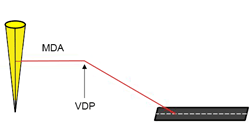
VDP is the point in the approach where the pilot must make the decision to land or go around again.
The question has been asked if a pilot must adhere to the VDP missed point when a VDP icon displays on the profile view of a WAAS approach plate, and the pilot is using the lowest LPV minima.
We have also been asked if CAT terms are used in reference to WAAS, or if they are ILS nomenclature only.
Let's dive in.
VDP Missed Point Adherence
Visual Decent Point or VDP is sometimes referenced on non-precision straight in approaches for WAAS (Wide Area Augmentation System) equipped aircraft. VDP is the point in the approach where if the pilot has the runway in view, they may continue their decent using the standard 3 degree decent angle to the runway threshold. If you do not have the runway in sight at this point, you must initiate a missed approach.
VDPs are seen on approaches farther out than normal Minimum Descent Altitude (MDA) and this is normally due to terrain or obstacle considerations.
CAT Nomenclature
We have also been asked if the terms Category (CAT) 3, CAT 2 etc. are used when speaking of WAAS, or if they are only Instrument Landing System (ILS) nomenclature.
CAT terms are ILS approach nomenclature, and don't apply to WAAS. CAT 1 is the approach that we see with the ILS approaches that takes the aircraft down 200 feet Above Ground Level (AGL) and requires one half mile visibility. This is used by the vast majority of pilots in the U.S. A CAT 2 approach allows descent below 200 feet (but not less than 100 feet) with only 1,200 feet of visibility. This approach involves greater expenses, as it requires additional training for the crew and stringent testing and calibration of the navigation equipment including the radar altimeter and other navigation systems. CAT 3 is the most precise and this will take an aircraft below 100 feet with visibility of about 650 feet. Of course, this is the most stringent approach and requires further approvals and training.
If you have any questions about WAAS, or any other avionics installation related question, please feel free to contact me. I will be happy to help!
Gary Harpster serves as an Avionics Installations Sales Rep. at Duncan Aviation's full-service facility in Lincoln, Neb. (LNK), specializing in Hawkers and Learjets. He has given WAAS presentations across the U.S., co-authored the "Straight Talk About WAAS" booklet and "Upgrading to WAAS" guide, and hosted the widely viewed WAAS video series. He began his career in aviation in 1977.
For more updates from Duncan Aviation, please follow us on Twitter and become a fan on Facebook.
Posted by Diane Heiserman on Wed, Sep 05, 2012 @ 12:00 PM
Contributed by Gary Harpster, Avionics Sales Representative

A WAAS/LPV approach eliminates altitude errors caused by extreme temperatures.
The altimeter reading in an aircraft with Air Data Computers, displays the altitude based on barometric pressure. Temperature plays a role in the accuracy of this information. When the air is cold, it is condensed and the altimeter reading will be less than the true altitude. Conversely, in hot weather the uncompensated altitude will bring the aircraft higher than the published alt constraint. That is why settings must be adjusted by the crew based on the readings provided by Air Traffic Control (ATC) or the controlling agency for the area they are flying in. This adjustment can be 100-300 feet depending on the temperature.
During an approach with WAAS/LPV, the initial vertical guidance is computed by the Flight Management System (FMS) based on the current altitude the aircraft believes it is flying at. At some point during the approach, the vertical guidance computed by the Air Data Computers will transition over to vertical guidance from GPS satellites. Once this transition occurs, the Air Data Computers are removed from the equation and the altitude error, caused by extreme temperatures is no longer a factor. With GPS, the descent is merely a mathematical equation based on current GPS altitude and selected three dimensional approach path.
Straight Talk Books
Duncan Aviation's free Straight Talk books are an aircraft operator's source for easy-to-understand information about WAAS/LPV and many other important topics in business aviation today. These publications are written by Duncan Aviation's very own aviation experts, and the authors are just a phone call away. Download your free copies at http://www.duncanaviation.aero/straighttalk.
Duncan Intelligence Live IA Seminar
Next Generation initiatives continue to become a reality in the aviation community. Get a more in depth look into the complicated subject of FANS at the next Duncan Intelligence Live IA Seminar. Steve Elofson, Duncan Aviation Avionics Sales Rep will be presenting his IA-approved class on FANS. Register now for this face-to-face forum discussion with industry experts and earn 8 hours of Inspector Authorization (IA) renewal credit.
Gary Harpster is an Avionics Sales Representative at Duncan Aviation's Lincoln, NE, facility, specializing in the Hawker and Learjet airframe. His aviation career began in 1977.
For more updates from Duncan Aviation, please follow us on Twitter and become a fan on Facebook.
Posted by Sarah Naeher on Tue, Jan 18, 2011 @ 09:00 AM
2010 was a busy year. We fielded countless avionics and paint questions, launched a blog, introduced a series of field guides and beefed up our YouTube channel with some new videos. Here’s a rundown of our most popular resources on DuncanAviation.aero last year.
1. Upgrading to WAAS: Answers From Industry Experts
The WAAS/LPV field guide was our most popular download last year. It addresses common questions from operators, differences between approval processes, discrepancies in upgrade costs and considerations for planning an upgrade.
2. Paint, Maintenance & Turbine Aircraft Value
The runner-up was an aircraft paint field guide, which targets common misperceptions about exterior refurbishments. It addresses the necessity of regular paint maintenance, aircraft market value considerations and criteria for selecting an aircraft paint service provider.
3. Straight Talk About WAAS
This WAAS eBook continued to attract attention last year with its discussion about the importance of WAAS, why it impacts business aviation operators and how it works.
4. Company Video: “Our Work Speaks for Itself”
A four minute video about Duncan Aviation debuted on our YouTube channel last year, highlighting our history, service philosophy, customer observations, capabilities and facility locations.
5. Understanding WAAS/LPV Video Series
Avionics Installation Sales Rep and long-time AEA Advisory Board Member Gary Harpster hosted this five-part WAAS video series based on the presentations he gave across the country last year. The series offers more technical information on legacy interface problems, LPV approaches, GPS signals and operational benefits.
More downloads are planned for release this year, so stay tuned! Additional resources that didn’t make our top five list can be found at www.DuncanAviation.aero/downloads.
For more updates from Duncan Aviation, please follow us on Twitter and become a fan on Facebook.
Posted by Diane Heiserman on Tue, Aug 17, 2010 @ 02:58 PM
Written by Gary Harpster, Duncan Aviation Avionics Sales Rep.
How does WAAS work?
WAAS uses the existing GPS satellites that are currently in orbit for the geometric aspect of the equation, a basic triangulation from multiple satellites to your position in three dimensional space. The problem is, in using raw GPS signals, is there are various forms of interference (atmospheric disturbances, satellite position error ..etc.) that play a part in the received signal. WAAS Receivers use a very precise timing signal to filter out this error and give you a higher degree of position accuracy, so much so, that the defined vertical accuracy is more precise that your altimeter in unusual temperature (both hot or cold) conditions.
What do all those new acronyms (HAL, VAL, HPL, VPL, LPV) really mean?
These terms really are not something you as a pilot need to be concerned with, these are acronyms the manufacture wants to make sure their box meets during certification. When a manufacturer designs a WAAS receiver they test their components to meet these specifications. As a pilot, you're mostly concerned with the proper WAAS approach plate and the LPV decision altitude (DA)
HAL - Horizontal Alert Limits
VPL - Vertical Alert Limits
HPL - Horizontal Protection Limit
VPL - Vertical Protection Limit
LPV - Localizer Performance with Vertical guidance
What new rules apply to WAAS users?
No new rules really, the FAA recently published there are now over 2,200 WAAS LPV approaches and that Europe is in the process of adding WAAS approaches over there.
How are WAAS-based approaches constructed
Before any airport is granted a WAAS approach, it must meet the design criteria called out in the FAA Advisory Circular 150/5300-13. Some of the requirements are the amount of space they consider the PFOZ Precision Obstacle Free Zone, Runway Edge Lighting, Parallel Taxiway and a Vertically Guided Airport Airspace Analysis Survey. As you can imagine the airport has to be surveyed to make sure there are no obstacles in your flight path and the decent rate can not be anymore that a typical ILS approach. You will not find a WAAS approach into a valley, where the airport is surrounded by obstacles that could potentially block your GPS signal as you near your minimums.
What are the similarities and differences between WAAS-based approaches and ILS, VOR, or non-augmented GPS?
A WAAS with LPV approach is very similar to an ILS approach, as the aircraft receives both lateral and vertical guidance just like an ILS with the same or better precision. The main difference is ILS signals are generated from transmitters located on the ground and aimed at the designed flight path, whereas a WAAS with LPV approach is getting the signals from satellites in orbit. VOR approaches provide lateral guidance from signals generated by transmitter on the ground. VOR approaches are commonly referred to by pilots as "dive and drive" approaches, this stems from the fact that during this approach you follow a lateral signal for a certain length of time, then when you cross a predefined waypoint calculated by another external reference point you are allowed to descend again for a period of time. This method continues until you are at a minimum decent allowance where you are then required to make visual identification of the airport for landing.
For more updates from Duncan Aviation, please follow us on Twitter and become a fan on Facebook.
Posted by Diane Heiserman on Thu, Jul 29, 2010 @ 02:39 PM
Gary Harpster, Duncan Aviation Avionics Sales Rep, concludes Understanding WAAS & LPV video series by answering some important questions about LPV:
- What is it?
- What equipment is required?
- Where are LPV approaches available?
View the complete WAAS/LPV video series at www.DuncanAviation.aero/videos.
For more updates from Duncan Aviation, please follow us on Twitter and become a fan on Facebook.
Posted by Diane Heiserman on Thu, Jul 22, 2010 @ 01:43 PM
Gary Harpster continues the Understanding WAAS/LPV video series explaining how WAAS has far reaching benefits to operators, airports and the overall general aviation operation at large.
Learn how WAAS changes navigational system accuracy, approaches, flexibility, precision, fuel savings and government and airport costs. Operational benefits and Next-Gen considerations are also discussed.
View the complete WAAS/LPV video series at www.DuncanAviation.aero/videos.
For more updates from Duncan Aviation, please follow us on Twitter and become a fan on Facebook.
Posted by Diane Heiserman on Thu, Jul 15, 2010 @ 01:09 PM
Gary Harpster, Duncan Aviation Avionics Sales Rep continues the Understanding WAAS & LPV video series.
WAAS is supported by a sophisticated infrastructure across the United States consisting of Wide Area Reference Stations (WRS), Master Stations (WMS) and a terrestrial satellite network. Learn how the WAAS signal interacts with GPS, eliminating inaccuracies and providing precision approach information.
View the complete WAAS/LPV video series at www.DuncanAviation.aero/videos.
For more updates from Duncan Aviation, please follow us on Twitter and become a fan on Facebook.
Posted by Diane Heiserman on Thu, Jul 08, 2010 @ 01:01 PM
Gary Harpster, Duncan Aviation Avionics Sales Rep explains all you need to know about WAAS & LPV for corporate aircraft and what's going on in our industry, covering operations, safety and efficiency benefits.
Business Aviation has another group of letters to add to its alphabet soup of acronyms. WAAS, Wide Area Augmentation System, is an extremely accurate navigation service which utilizes a combination of the Global Positioning System (GPS) satellites and Geostationary Satellites to improve the GPS navigational service. But what is it? How does it work? And will it be where I need it?
Questions about WAAS/LPV? Ask them on the What is WAAS? video page.
View the complete WAAS/LPV video series at www.DuncanAviation.aero/videos.
For more updates from Duncan Aviation, please follow us on Twitter and become a fan on Facebook.
Posted by Diane Heiserman on Thu, Jul 01, 2010 @ 01:34 PM
Gary Harpster, Duncan Aviation Avionics Sales Rep introduces the Understanding WAAS & LPV video series with a brief overview of key topics to consider if your aircraft isn't equipped with WAAS, including legacy interface problems, field approvals, annunciators, NextGen criteria and how to determine if your aircraft is a candidate for an upgrade.
NextGen is the next generation of air traffic control and aviation communication/navigation. WAAS/LPV is the latest in aircraft avionics and will be necessary to meet NextGen criteria. But there are many things you must consider before heading down the road towards this upgrade.
Questions about WAAS/LPV? Ask them on the WAAS Considerations video page.
View the complete WAAS/LPV video series at www.DuncanAviation.aero/videos.
For more updates from Duncan Aviation, please follow us on Twitter and become a fan on Facebook.