Posted by Adrian Chene on Tue, Dec 06, 2011 @ 03:29 PM
Contributed by Adrian Chene , Avionics Installation Tech Rep.
This photo illustration demonstrates how a laptop can interface with cabin entertainment systems to improve team collaboration.
High Speed Data technology for the aviation industry has reached a level where it now supports most office activities aboard an aircraft allowing a team to continue to collaborate, share and analyze data, ideas and workload.
The following are three methods to increase employee connection and productivity while in flight.
Laptop Video Interface
When installing a new cabin video system, always request a laptop video interface. With this, business travelers are able to use their laptops to share presentations and documents on cabin monitors. Such a simple measure allows a team to continue collaboration and work on complex projects. It also permits sales teams to practice the "big pitch" on the way to the client.
Carry-on Encrypted Network Drive
A carry-on encrypted network drive is simply an external hard drive that uses a separate power supply and an Ethernet connection. These are easily encrypted to permit access to only those who require access. A single network drive would allow multiple people access to different portions of a larger project and then return those worked pieces prior to landing. Teammates will also have access to each other's working documents for brainstorming.
Data Encryption
An aviation-grade router that supports encrypted communication provides a secure link between your aircraft's router and the home network. This secure link allows travelers to receive sesitive data from the homeoffice while traveling. EMS, Lufthansa Technik and True North's Chorus system have routers that support data encryption and acceleration options. For many, the answer to which router is needed is going to depend on the availability of a STC for Wi-Fi.
The world is moving fast at faster speeds. Critical work and team collaboration isn't reserved for just the office on the ground. It has become critical for flight departments to create the perfect office in the sky.
Duncan Aviation answers common issues and questions about Wi-Fi installations for business aircraft in a new field guide entitled "Making Sense of Wi-Fi: An Operator's Guide to Aircraft Internet Options." The guide explores the various topics operators face when selecting Wi-Fi for business aircraft, and includes a comparison of the major service providers and main equipment options for business aircraft. To download a copy, please visit www.DuncanAviation.aero/fieldguides.
Adrian Chene is an Avionics Tech Rep for Duncan Aviation. He provides troubleshooting and technical advice on avionics installation services, and specializes in custom, integrated HSD solutions. He began working in aviation in 1996.
For more updates from Duncan Aviation, please follow us on Twitter and become a fan on Facebook.
Posted by Sarah Naeher on Tue, Jul 19, 2011 @ 03:34 PM
Contributed by Steve Elofson, Avionics Installations Sales Rep.
Identifying where an aircraft operates is a critical step to selecting a Wi-Fi solution. Please check with each provider for the latest coverage information.
Understanding the features, capabilities, and service levels that come with each Wi-Fi and inflight internet system can get confusing. There are several aspects that need careful consideration, namely which inflight internet system best fits the passenger needs.
Evaluate passenger needs.
An aircraft’s high-speed data (HSD) system is what provides the inflight internet connection for Wi-Fi in a business aircraft. Before selecting a system, a thorough understanding of passenger needs is essential. Do passengers want wired or Wi-Fi access? What devices will they use? Where will they fly? Will they need access to e-mail attachments? Will they need high-speed internet? Will they need to connect to a VPN?
Evaluate what’s currently installed on the aircraft.
When customers request in-flight internet options, one of the first questions I ask is “Do you have a Satcom system?” Many times, customers already have a voice or data system that can be upgraded to support HSD and Wi-Fi connectivity. Examples of aviation-grade equipment include: Aircell’s Cabin Telecommunications Router (CTR), which can be added to an existing Aircell Gogo Biz™ Inflight Internet system; EMS Aviation’s CNX-200, and Honeywell’s CG-710. Other HSD systems like Thrane & Thrane and True North have a built-in Wi-Fi router.
Understand the usage costs.
Some HSD providers offer unlimited usage, others charge by the megabyte. It’s important to clearly understand each HSD plan so you aren’t surprised by the service costs after the aircraft leaves the hangar. For example, Gogo Biz offers an unlimited usage plan for a monthly fee. Systems available through SatCom Direct are typically billed by the amount of data used.
Determine which system offers the speed and coverage passengers need.
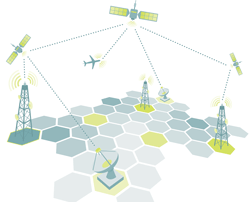
Different inflight internet service providers offer a variety of internet speeds and are available in different geographic regions around the world. Gogo Biz currently offers a very fast high-speed internet connection via a ground-based network in the continental U.S. SatCom Direct provides service for a variety of different satellite-based systems with different connection speeds, such as Inmarsat and Iridium, which provide near-global coverage.
Sometimes more than one HSD solution can be installed in an aircraft to increase internet accessibility. A fast, domestic system can be installed alongside an international-capable system. Depending on the systems and router used, the transition from one service to the next can be almost seamless when crossing into areas with different coverage.
No matter what system you choose, I highly recommend using an authorized service center to install HSD and Wi-Fi systems. An authorized service center with equipment dealership agreements will have a better understanding of the aircraft, and will have greater support from the equipment manufacturer.
Duncan Aviation has installed more than 100 HSD systems over the last three years, most of which have included Wi-Fi routers. We hold several airframe service center authorizations, and have many Wi-Fi STCs covering many makes and models. Installations can be accomplished at either of Duncan Aviation’s full-service facilities in Battle Creek, Mich. or Lincoln, Neb.; or at any of Duncan Aviation’s network of avionics shops located in more than 20 cities across the United States.
Read the expanded article in the summer edition of the Duncan Debrief magazine, available online next month.
Steve Elofson serves as an Avionics Installations Sales Rep. at Duncan Aviation’s Lincoln, Neb. facility, specializing in Challenger aircraft. He began working in aviation in 1989.
For more updates from Duncan Aviation, please follow us on Twitter and become a fan on Facebook.
Posted by Diane Heiserman on Thu, May 05, 2011 @ 05:00 PM
Contributed by Adrian Chene, Avionics Tech Rep.
Your inflight internet service provider should be able to determine why a connection failure occurred.
With any high-speed data (HSD) connection, there are times and places where connectivity will be lost, particularly in geographic areas with high internet usage or when transitioning between satellite signals.
Congestion occurs when an internet service provider is unable to handle the number of users on their network and begins to throttle back available bandwidth and/or drop users. This is more common during the afternoon and in airspace with a high number of internet users logged in, like New York City or Chicago.
Inflight internet services that offer moderate- to low-speed satellite-based connections, like Inmarsat, tend to experience more issues with network congestion. Ground-based high-speed connections, like Aircell, have more bandwidth at their disposal, which greatly reduces the effects of congestion. Aircell also monitors network use more closely to ensure more evenly distributed bandwidth.
It is also common to momentarily lose connectivity when switching between satellite signals during transcontinental flights.
Your service provider should be able to determine if a connection failure occurred due to congestion or when switching between satellite signals. Usage Logs can also provide clues to the nature of the service interruption. Both Aircell and Inmarsat are able to provide usage logs upon request. If troubleshooting the link between the CNX and your home network, CNX-200s will allow usage log downloads for evaluation by EMS or your service provider.
For help troubleshooting an internet connection issue in your aircraft, contact the Duncan Avionics installation and line maintenance location nearest you.
Adrian Chene is an Avionics Tech Rep for Duncan Aviation. He provides troubleshooting and technical advice on avionics installation services, and specializes in custom, integrated HSD solutions. He began working in aviation in 1996.
For more updates from Duncan Aviation, please follow us on Twitter and become a fan on Facebook.
Posted by Diane Heiserman on Tue, Apr 19, 2011 @ 09:49 AM
Contributed by Adrian Chene, Avionics Tech Rep.

A failed router RF module and/or configuration module is a very common failure that will prevent passengers from connecting to the internet.
It is a common mistake for crews to report a failed Wi-Fi router (wireless cabin network) as a failed high-speed data (HSD) internet connection instead. To isolate an internet connection problem, first check the router functionality.
Plug a laptop into the ‘hardwired’ Ethernet ports located in the cabin to verify the router is powered and other basic functions are operable. You do not need an internet connection.
If the Ethernet ports are functioning but the Wi-Fi is dead, then the router RF module and/or configuration module has failed. This is a very common failure, and in certain systems it's the number one reason passengers are unable to connect to the internet.
If the aircraft has an Inmarsat only install, the cabin router is solely responsible for the cabin network.
If the aircraft has an Aircell installation, the Aircell CTR and/or Aircell ATG are possible causes of the network failure. These can be tested by going to the unit’s information page located on the system LAN.
If the Ethernet ports and router are functioning correctly, but you still don’t know why your passengers were unable to connect to the internet, ask your HSD provider.
For help troubleshooting an internet connection issue in your aircraft, contact the Duncan Avionics installation and line maintenance location nearest you.
Adrian Chene is an Avionics Tech Rep for Duncan Aviation. He provides troubleshooting and technical advice on avionics installation services, and specializes in custom, integrated HSD solutions. He began working in aviation in 1996.
For more updates from Duncan Aviation, please follow us on Twitter and become a fan on Facebook.
Posted by Diane Heiserman on Fri, Apr 08, 2011 @ 01:01 PM
Contributed by Adrian Chene, Avionics Tech Rep.
Knowing the right questions to ask is important when troubleshooting HSD failures.
High-speed data (HSD) failures are difficult to troubleshoot, and require several different skill sets. The most important skill needed is knowing which questions will yield the best results. The price for poor troubleshooting is very high, and my number one recommendation is to get advanced troubleshooting experts involved early.
Here are four steps to troubleshoot why passengers can’t connect to the internet onboard an aircraft. I will also explore each topic in further detail in future posts.
1. Check the router.
Plug a laptop into a ‘hardwired’ Ethernet port in the cabin to verify the router is powered and other basic functions are operable (an internet connection is not necessary). If the Ethernet ports are functioning, but the Wi-Fi is dead, then there is a problem with the router.
2. Verify there wasn’t a connection loss.
There are times and places where connectivity will be lost due to congestion. This is more common in afternoons and airspaces where lots of users are logged in, like New York City or Chicago. It is also common to momentarily lose connectivity when switching between satellite signals during transcontinental flights. Your service provider should be able to tell you if a connection failure was caused by congestion or while switching satellites.
3. Send fault logs to the service provider and equipment manufacturer.
Most HSD terminals have fault logs that can be downloaded to assist in troubleshooting. Send these logs to your service provider and equipment manufacturer technical reps.
I always recommend that operators contact their field service and equipment manufacturer technical representatives, and get them involved early. If you don’t know who your representatives are, ask the facility that installed the equipment.
4. Hire a professional for ancillary system troubleshooting.
For ancillary system issues, such as Sat AFIS/ACARS, save your time and hire a professional to assist you. In many cases the satcom and datalink service providers are companies with competing services, and unfortunately a fair amount of accusation can take place between the two. To reduce confusion and root out the error relatively quickly, get both parties on a conference call.
For help troubleshooting an internet connection issue in your aircraft, contact the Duncan Avionics installation and line maintenance location nearest you.
Adrian Chene is an Avionics Tech Rep for Duncan Aviation. He provides troubleshooting and technical advice on avionics installation services, and specializes in custom, integrated HSD solutions. He began working in aviation in 1996.
For more updates from Duncan Aviation, please follow us on Twitter and become a fan on Facebook.
Posted by Diane Heiserman on Tue, Dec 21, 2010 @ 09:00 AM
Satcom Security Issues in Business Aviation: Part 1
Contributed by Adrian Chene, Avionics Tech Rep
The very networks used to communicate satcom system transmissions can be used to compromise network security aboard business aircraft.
To say that large corporate networks are under daily attack by hackers and cyber-spies is a gross understatement. What is interesting about these attacks is that they rarely ever start at some screen that says "password." They involve custom software applications that function as any predator does: by systematically exploiting weaknesses.
Network Security Risks
Bizjet operators whose passengers deal with sensitive information in foreign nations face real threats from several angles. The very networks used to communicate satcom system transmissions can be a serious point of compromise.
Russia, China and Australia currently require that all Inmarsat terminals that log on inside their border have traffic forcefully rerouted to centralized traffic management points (government servers). This can be troubling for operators seeking to do business abroad.
Although it is impossible to stop the interception of your communications, you must take steps to secure it. The most efficient way to address this is to encrypt the information you are sending with a software or hardware intermediary.
Hardware Encryption
An investment in airborne routers, such as the CNX-200 by EMS, can employ VPN Tunneling at the hardware level. In my opinion, this is the more productive and preferred method because it creates a secure data pipe between your network and your aircraft without a decrease in data transmission rates. Maintaining average speeds of 700-800 Kbs using a sister gateway unit on the company’s network. The tunneling and encryption takes place behind the scenes and does not require any action by your passengers.
Software Encryption
There are a myriad of applications available that will encrypt information without additional hardware; making this a very inexpensive option. Cisco’s VPN Client is one such software-driven solution. While inexpensive, software-based solutions an adverse effect on the maximum speed of your Internet connection, cutting it in half to about a 400 Kbs pipe.
A hacker’s network server monitoring traffic would be hard pressed to intercept your transmissions in any type of useable form from either of these two options.
In part 2 of Satcom Security Issues in Business Aviation, I will discuss physical security measures you can adopt to stymie foreign operatives.
Adrian Chene is an Avionics Tech Rep for Duncan Aviation. He provides troubleshooting and technical advice on avionics installation services, and specializes in custom, integrated HSD solutions. He began working in aviation in 1996.
For more updates from Duncan Aviation, please follow us on Twitter and become a fan on Facebook.
Posted by Diane Heiserman on Wed, Sep 08, 2010 @ 02:15 PM
Contributed by Gary Harpster, Avionics Installations Sales Rep

"Wi-Fi in the sky" is the latest aviation industry milestone for improving passenger productivity. Image source: Aviation Week.
The phrase “office in the sky” dates back to when passengers were first able to pick up a phone while in the air and make a call to anywhere in the world. Now for the first time ever, another major milestone: "wi-fi in the sky," or the ability to use high speed internet while airborne.
So how is inflight internet accomplished and what does it take to install? I was interviewed for a recent Aviation Week blog post "Clearing WiFi To Fly," in which Paul Seidenman and David J. Spanovich explain that lots of testing is involved.
"The current approval route for onboard WiFi equipment on U.S. registered aircraft is through an “issue paper,”... which spells out the testing procedure that the installer must follow to assure that the WiFi equipment—the router, transceivers, associated wiring and external antenna—will perform its intended function and shield the aircraft’s electronics from any interference from a portable electronic device.
"According to the FAA, the aircraft’s operating certificate holder is the only one who can [qualify the aircraft as transmitting portable electronic device-tolerant], based on the testing done by a maintenance provider."
In the post, I explain that a multi-step testing process is necessary and rigorous. Technicians place "rogue transmitters" at each seat in the aircraft to simulate passenger wireless device connectivity with the inflight Wi-Fi suite.
The test is specific to each aircraft make, model and avionics configuration. Technicians carefully document the procedure and any abnormalities with the aircraft's electronics, which becomes part of the STC application.
"...[A]n STC for WiFi... enters a multi-step approval process, which begins at field level and concludes at the FAA’s Transport Directorate Office in Seattle. For a number of shops, especially those without organization designation authority [ODA], that could mean getting into a sequencing situation and as much as a 90-day waiting period, depending on field office work load."
For more details on the testing and development of inflight internet STCs, please read Aviation Week's "Clearing WiFi To Fly" blog post.
I also recommend reading Duncan Aviation's press releases on the completion of the first STC for Aircell's Wi-Fi system in a Challenger 300, and our Organization Designation Authorization (ODA) approval.
For more updates from Duncan Aviation, please follow us on Twitter and become a fan on Facebook.
Posted by Adrian Chene on Tue, Aug 10, 2010 @ 12:08 PM
Look for the aviation certification of the Wi-Fi equipment
Carefully examine the proposal of the installing company and question the technical data by which the Wi-Fi connection is being installed. Aviation grade Wi-Fi equipment often has FAA or EASA certifications or Supplemental Type Certificates (STC) that accompany them. STCs certify that the equipment to be installed has been tested in that particular model and found to be safe.
Examine what equipment they are proposing for install
Do not permit a commercial Wi-Fi system to be installed. Use ONLY aviation approved parts. Commercial Wi-Fi systems are likely to transmit the aircraft signal too far, creating security risks. These units have also not been tested for interference with other aircraft systems. Commercial Wi-Fi systems should also be avoided since high speed data (HSD) equipment manufacturers will provide limited technical support for these less expensive interfaces.
Choose a company who is a dealer for both the Wi-Fi and HSD equipment
Many avionics installers have dealership agreements with the manufacturers of HSD equipment that connect to Wi-Fi systems. If your Wi-Fi system fails and extensive troubleshooting becomes necessary, dealers who sell and service many units will receive the highest level of support from the manufacturers, compared to the one unit that a smaller shop might sell. Avionics installers who are dealers for both HSD equipment and Wi-Fi equipment are the most capable of resolving any conflicts of equipment that may occur and therefore should receive preference.
Make sure the company installing the equipment has the expertise to accommodate the highest level of security required
It is essential that you are able to provide your passengers with the highest level of computer security they require. Ask about what security measures the avionics installer is familiar with and have installed in the past. If they do not seem studied on the topic, do not use them. Information security is very critical. Your company’s computer specialists may have to work with the avionics installer to ensure everything is set up properly.
What methods should be used to test the Wi-Fi installations? After a Wi-Fi system is installed, it should be tested in the same way that your customers will use it. Standard connectivity and speed tests will tell you if the equipment is performing basic functions. From there it will be up to you and your IT department to further define the details of system configuration. Your installer should be your partner in this effort.
If smart phone connectivity is the most important to you, then make sure you plan for testing using the same model, set up the same way by your IT department. If your company has VPN client software, make sure to take a company laptop. The installer should support any testing you may seek, the same as they would any other service.
For more updates from Duncan Aviation, please follow us on Twitter and become a fan on Facebook.
Posted by Sarah Naeher on Tue, Jul 27, 2010 @ 12:39 PM
I’ve been skeptical of in-flight internet and High-Speed Data (HSD) since I first started hearing about it. Internet speeds like my home or office network? I had to experience it to believe it. On a recent flight, I got that experience.
Within 7 minutes after takeoff I was online with Aircell's Gogo service, which is the commercial airlines equivalent of High Speed Internet for business aviation. I checked my e-mail, tweeted, updated a website, did some research online and chatted with my husband (who, after a few moments of confusion, commented the accessibility was “very cool”). It was more than cool. It was, truly, just like being in the office.
How fast is fast? The speeds are advertised at up to 3.1 mbps. Webmail is snappy. FTP uploads and downloads are speedy. I even watched Robert Duncan, Chairman Emeritus of Duncan Aviation and pilot of Dove 1 for the Special Olympics, in an interview on YouTube at http://www.youtube.com/watch?v=-XH4XM8CWIg.
The connection did lag at times and I had been warned beforehand that the advertised speed is sometimes more of an exception than the rule (not unlike my home internet connection). The number of users, among other factors, can affect connection speeds. Connection speed analyzers aren’t necessarily accurate as the lag time (or latency) between the aircraft and the ground-based stations can skew the results. Even so, I was pleasantly surprised.
Is Aircell’s High Speed Internet for everyone? It depends on the needs of the passengers. Gogo and its High Speed Internet equivalent is only available in the United States above 10,000 feet. Some passengers may not need the faster connection speeds, and aircraft that frequently make international flights may need to consider other solutions.
After landing, I wasn’t any slower to reach for my cell phone, but I did accomplish more during my flight with in-flight internet. That productivity, in my opinion, is priceless.
For more updates from Duncan Aviation, please follow us on Twitter and become a fan on Facebook.
Posted by Adrian Chene on Tue, May 18, 2010 @ 01:17 PM
When you discuss communications security, eyes tend to glaze over. Most aviation professionals are used to things they can see, feel or in some way measure. When a router setting won't permit you to connect to the web anymore, no amount of visual inspection will help. It's just a black box until your IT guys make sense of it for you. That being said, I promise to keep this conversation to the point and as straight forward as possible.
HSD (High Speed Data) systems have become an integral part of flight departments with several solutions available, both ground- and satellite-based. However, when you look at onboard security of HSD systems, there are many weak points where a hacker can attack; the first being, the router.
Wi-Fi routers are popular onboard jets because they offer convenience for customers receiving e-mail updates with their blackberries. This is essentially a sophisticated radio and like any radio its signal can be easily intercepted. Of course, from the router the data goes to the satellite or ground-based network and then on to the Internet, where there are numerous points traffic can be intercepted. Information traffic security is the second biggest challenge for any work-away-from-home network.
Knowing where you're most vulnerable with security will empower you to increase your level of protection. While the following recommendations are by no means comprehensive, they do represent the start of a conversation that will hopefully increase the security of your onboard network.
The steps to tighten Wi-Fi security without any inconveniece
1. Turn the router SSID broadcast off.
Most wireless routers automatically transmit their network name (SSID) into open air at regular intervals (every few seconds). This allows passengers to easily find and access your system. However, this feature also makes it easier for hackers to intrude as well. If you are lucky enough to have the same passengers using the same computers and phones all the time you can turn this broadcast off and set the SSID to something other than the aircraft tail number.
2. Assign an encryption type and wireless passkey to your router.
I generally use WPA encryption with a pass-key as a baseline for airborne router security.
3. Install a Wi-Fi disable switch.
One of the simplest ways to protect your client's satcom bill, computers and blackberries is by disabling the Wi-Fi on the ground. The last thing you want is a teenager at the FBO updating their Facebook on your SwiftBroadband. Have your satcom installation provider place a switch in your cockpit if one is not there already.
4. Add Wi-Fi instructions to your pilot's checklists.
You are probably safe to enable the Wi-Fi as you taxi away from an FBO. These systems have a very limited range and someone would need serious RF know-how to sniff your network at 1000 yards with an airborne router.
5. Have your passengers get plugged in.
If your clients must use the satcom system prior to taxi, provide them with an Ethernet cable and ask them to plug in. The benefit of this is two-fold: 1) This will allow your customers to surf the web with the Wi-Fi disabled and 2) it will improve the performance of their connection slightly.
Wired Ethernet connections outperform Wi-Fi generally, though on a typical SwiftBroadband network the difference will be negligible.
6. Other security protocols.
There are a myriad of other security measures that will reduce the likelihood of a cyber attack, such as MAC address filtering. Which security protocols will work best for you will often depend on the demands of your clients.
Wi-Fi signals are easily intercepted, and for that reason they are particularly vulnerable to manipulation. With that being said, your best defense against an experienced hacker is to not be an easy mark. Developing your own WIFI security measures alone can often deter the would be hacker.
Stay tuned for part 2 of HSD Security, "The Good, The Bad and the Not-So Ugly of VPNs."
Adrian Chene, Avionics Tech Rep
For more updates from Duncan Aviation, please follow us on Twitter and become a fan on Facebook.