

Subscribe by Email

Your email:

The Duncan Download Blog: Business Aviation Advice & Observations

Current Articles | RSS Feed RSS Feed

Challenger Landing Gear Hidden Corrosion


Contributed by Jerry Cable, Accessory Tech Rep

Challenger landing gear requires a detailed inspection at 60 months for the 600 and 601 and 96-months for the 604 and 605. It must then undergo a 120-month restoration for the 600 and 601 and 192 month for the 604/605.

The reason for these inspections is to check for cracks, wear and corrosion. Years of water, dirt, salt air, fluid and various other electrolytes have taken their toll. The gear is very susceptible to corrosion and even though steps may have been taken to lessen the effects, some corrosion still forms.

Corrosion is normally found throughout the gear but can often be repaired using standard repair schemes available in the CMM or through engineering concessions. Sometimes, however, the corrosion has exceeded the limits of those repair tolerances.

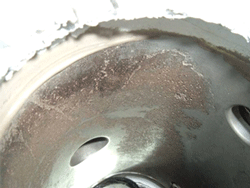
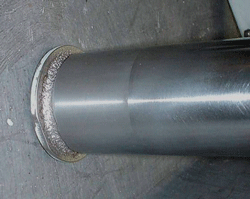
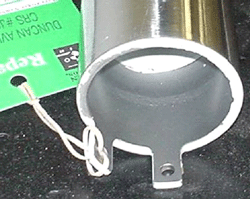
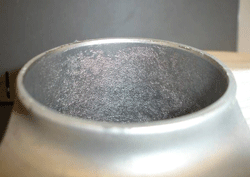
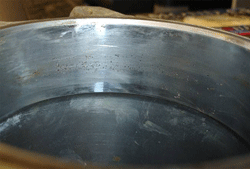
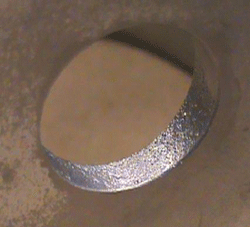
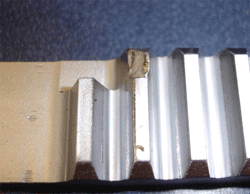
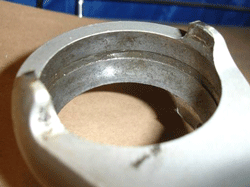
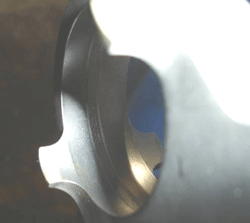
Some of the more severe corrosion found during these inspections is detailed in the following photographs.

Challenger MLG Trailing Link

MLG Trailing Link

  • Axle Bore corrosion found in 35% of the restorations.
  • Engineering Concession can be requested.
Challenger MLG Side Strut Pin

MLG Side Strut Pin

  • Corrosion on OD radius found in 50% of restorations.
  • No repair schemes exist.
Challenger MLG Hinge Pin

MLG Hinge Pin

  • Corrosion on the ID mating with brake line swivels found in 70% of the restorations.
  • CMM details a repair scheme for the area.
Challenger MLG Oleo Pin

MLG Oleo Pin

  • Corrosion on the ID found in 65% of the overhauls.
  • No repair schemes exist for this area.
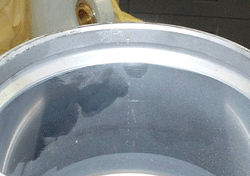
Challenger MLG Oleo Cylinder

MLG Oleo Cylinder

  • ID corrosion found in 50% of the restorations.
  • Engineering concession can be requested.
Challenger NLG Main Fitting

NLG Main Fitting

  • Corrosion under steering sleeve found in 50% of restorations.
  • Engineering concessions can be requested.
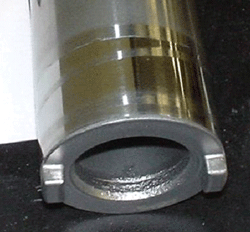
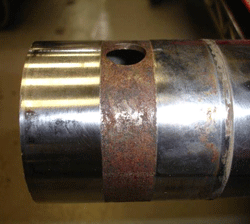
Challenger NLG Plunger Tube

NLG Plunger Tube

  • Corrosion, lower band mating with axle found on 75% of restorations.
  • CMM details a repair scheme for the area.

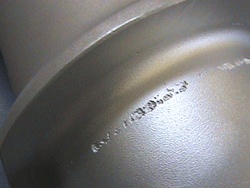
NLG Axle Barrel

  • Corrosion mating with plunger tube found on 75% of restorations.
  • CMM details a repair scheme for the area.
Challenger NLG Stering Cuff

NLG Steering Cuff

  • Corrosion in the ID Bore found in 60% of restorations.
  • CMM details a repair scheme for the area.
Challenger NLG Axle Transverse Bore

NLG Axle Transverse Bore

  • Corrosion found on 50% of the restorations.
  • CMM details a repair scheme for the area.
Challenger NLG Steering Rack

NLG Steering Rack

  • Tooth damage going to caster mode found during 90% of restorations.
  • No repair scheme available.
Challenger MLG Side Strut Rod End

MLG Side Strut Rod End

  • Bearing bore corrosion found in 85% of the restorations.
  • CMM details a repair scheme for the area.
Challenger MLG Side Strut

MLG Side Strut

  • Bearing bore corrosion found in 85% of the restorations.
  • CMM details a repair scheme for the area.
Jerry Cable is an Accessories Tech Rep located at Duncan Aviation’s Lincoln, Nebr., facility. He is a landing gear and accessory components and systems specialist. His aviation career began in 1991.

For more updates from Duncan Aviation, please follow us on Twitter and become a fan on Facebook.

Do Not Overlook the Adel Clamps (MS21919)


Contributed by Scott Shefke, Airframe Tech Rep

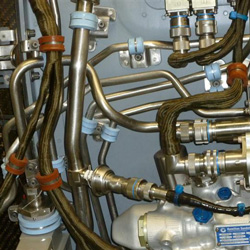
Adel Clamps

Error on the side of replacing when you have suspicions about an Adel Clamp (MS21919) on your business aircraft.

The wires that run throughout the aircraft and engine compartment need to be secured into bundles to prevent interfering with moving parts or chafing. During visual inspections, work cards will state to verify routing of electrical wiring, wiring harnesses, fuel lines, hydraulic lines and oxygen lines.

Adel Clamps, AKA MS21919 aircraft clamps, are key components used in line support, vibration dampening and maintaining proper clearance for lines or harnesses running throughout the aircraft structure. The Adel Clamp is a metal band constructed from aluminum, corrosion-resistant steel and low-carbon steel, covered by a white rubber lining or cushion made from silicone. Older Adel Clamps made from low-carbon steel had different colored cushions depending on what materials they were constructed from: silicone (red), ethylene propylene (purple), chloroprene cushion (black).

A visual inspection, no matter how trivial, needs to include the inspection of these clamps; and when necessary they need to be replaced. These cushions are exposed to heat, vibration, ozone and a variety of petroleum-based and synthetic-based fluids. Over the years, inspections have found cushions torn or missing, exposing the metal bands. In cases where the cushion is made from Teflon polyamide glass, dust gathered around the hardware or in the immediate vicinity indicates wear. These should be replaced.

We have found conditions were the cushion’s wrapping edge is in good condition, however, a more detailed examination reveals the cushion has worn away on the inside of the band, creating a bare-band-to-line or -wire condition.

When Adel clamps fail in these conditions, it has been noted on fuel systems to cause non-designed fuel migration, or a low fuel pressure situation. In hydraulic lines, Adel Clamp bands have been found rubbing through hydraulic system lines resulting in a loss of hydraulic quantity. Intermittent electrical faults have lead technicians to find an Adel clamp cutting into an electrical harness.

The MS21919 aircraft clamp is used safely by many aircraft OEMs with very little trouble. However, a skilled technician will be looking closely at these clamps and know that their replacement is not trivial nor being too picky. The repair costs of the many systems they support vastly outweighs the cost of this simple preventive maintenance approach.

Duncan Aviation has teams of experienced airframe mechanics provide service for almost every airframe maintenance event, scheduled or unscheduled. Emergency AOG service is available through our mobile Rapid Response teams. Technical support is available 24 / 7. We are authorized by several aircraft OEMs and foreign agencies around the world.

Scott Shefke is an Airframe Tech Rep located at Duncan Aviation’s Lincoln, Nebr., facility, specializing in the Challenger airframe. He sits on the OEM Advisory Committee reviewing fleet and maintenance issues reported by operators working to improve the Challenger aircraft. His aviation career began in 1991.

For more updates from Duncan Aviation, please follow us on Twitter and become a fan on Facebook.

How to Avoid Challenger 600 Epoxy Ramp Removal Damage


Submitted by Scott Shefke, Airframe Tech Rep

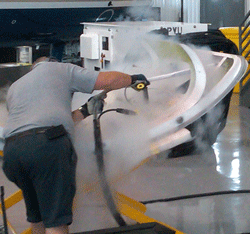
Challenger 600 Door Epoxy Ramp Removal

Duncan Aviation Maintenance Tech using the Aero 40 Series dry ice blasting machine.

Bombardier has released Service Bulletin (SB) for all Challenger 600 model aircraft. SB ATA 55-11 titled "SPECIAL CHECK/MODIFICATION – PASSENGER DOOR –EPOXY RAMP REMOVAL AND CORROSION PREVENTION."

According to the SB ATA 55-11:

There have been several reports of corrosion in the lower structural elements of the passenger door. It was determined that the epoxy ramp installed to prevent water accumulation could deteriorate with time and retain moisture. The purpose of this Service Bulletin is to remove the epoxy ramp to prevent further corrosion, add additional draining holes and modify the door structure to allow access to facilitate scheduled inspections.

Avoiding Collateral Damage

To help support our customers in performing this SB, all three of Duncan Aviation’s maintenance facilities (Lincoln, Nebr.; Battle Creek, Mich. and Provo, Utah) have obtained a cold jet Aero 40 Series dry ice blasting machine. This dry ice blasting machine is integral in removing the epoxy ramp in an efficient manner while ensuring no collateral damage to existing door structure occurs.

Technicians at all locations have been properly trained by Cold Jet, the blasting machine’s OEM. Duncan Aviation has successfully completed this SB in-the-field and have several more in-the-field events scheduled through the remainder of 2012.

For more information about the Aero 40 Series dry ice blasting machine and to schedule the completion of this SB, please contact Duncan Aviation’s Airframe Service Sales.

Scott Shefke serves as an Airframe Technical Representative at Duncan Aviation's full-service facility in Lincoln, Nebr., specializing in Challenger, Global and Learjet aircraft. His aviation career began in 1991.

For more updates from Duncan Aviation, please follow us on Twitter and become a fan on Facebook.

Duncan Aviation Technicians Travel the World in 2011


In 2011, Duncan Aviation team members made hundreds of trips around the world providing AOG services. While providing the most-needed AOG services to our customers on nearly every Continent, team members also took in some local culture, food and sites.

Berlin, Germany

Berlin, Germany

In March, Scott Shefke, Challenger/Global Tech Rep, traveled to Berlin,Germany, to perform and assess the viability of restoring a Challenger CL 604 to airworthiness status. The project included performing engine boroscopes, performance runs, system operations checks, fuel sampling and general condition of aircraft.

“Berlin is a magnificent city to visit,” says Scott. “It is rich with history.”

Cairo, Egypt

Cairo, Egypt

In Cairo, Egypt, Dan Soderstrom, Master Turbine Engine Mechanic, and Bill Walker, Engine Tech Rep, were in the right place at the right time when one project turned into two. While troubleshooting a faulty fuel control unit on a Hawker 800XP, a local Hawker 850XP operator approached them for assistance in fixing leaking starter/generator seals.

Both Dan and Bill said that everyone they had contact with in Egypt were very nice and helpful. Dan hopes to have more opportunity to see the great city if he gets the chance to go in the future.  

Bordeaux, France

St. Emilion, France

Ron Grose, Falcon Tech Rep, attended the annual Falcon 7X Steering Committee meeting in May, in Bordeaux, France, a beautiful old city located in southwestern France along the Garonne River, surrounded by elite vineyards. As a member of the steering committee, Ron and others oversee the development of the scheduled maintenance program for the Falcon 7X aircraft.

One of Ron’s favorite places to visit was the small village of Saint Emilion. It is a 1,700 year old village which was, at one time, surrounded by a large moat used for protection against the warring tribes. This quaint village had narrow cobblestone streets, great restaurants and many wine tasting shops.

Brisbane, Australia

Brisbane, Australia

Duncan Aviation Fuel System Lead Technician, Jon Abrahamsen, took a week long trip to Australia in May. He was dispatched to repair a wing junction plate fuel leak on a Falcon 2000EX.

Jon used one of his days to drive two hours down to Surfers Paradise, a large tourist beach. He also took the train downtown to the south shore for dinner and a couple of local beers. Jon says the area was beautiful.

Shanghai, China

Shanghai, China

Scott Howell, Airframe Lead Mechanic, along with three other fellow Duncan Aviation team members, traveled to Shanghai, China to complete a crucial fix on a Falcon 7X. Getting tools and equipment through customs posed a challenge, but the team stuck to the task, completing the project early.

On the first full day of their trip, the group made their way to The Bund, a mile long street lined with shopping. A local gentleman led them beyond the glamour of these stores to another area. Here, they had the adventure of walking up steep wooden stairs, entering into random people’s homes, where they bargained with local merchants for various items. It is an experience they will not soon forget. Scott describes the city’s transportation as very convenient and clean. The food was not what he would have suspected, but enjoyed trying the various delicacies of the region. 

Santo Domingo, Dominican Republic

Ned Shanks, Engine Rapid Response Tech out of Fort Lauderdale, FL, made a trip to Santo Domingo, Chile, in October to assist a customer. The #1 engine on their Lear 35 would not start. Having seen this squawk many times before, Ned suspected there was an issue with the aircraft’s igniter box and prepared for his trip with this in mind. This was a very important job because the aircraft was an air ambulance and was scheduled to fly a sick infant back to the United States for medical care.

After arriving, clearing Customs and making it to the aircraft, Ned quickly discovered his suspicions were correct, a failed igniter box. As soon as he complied with the removal and replacement of the box, ground runs and required paperwork, they were airborne and on their way back to Ft. Lauderdale. Shortly after arrival back home, the aircraft was prepped and sent out on another rescue mission.

For more updates from Duncan Aviation, please follow us on Twitter and become a fan on Facebook.

Avoid Hawker Landing Gear Exchanges During Maintenance Events


Contributed by Dan Fuoco, Hawker Airframe Service Sales Rep.

Hawker Landing Gear

Hawker roll-around nose landing gear (NLG) and main landing gear (MLG) used to keep aircraft moving through maintenance.

I’ve worked with Hawker maintenance events for a long time, and I make it my business to make sure everything is in place for an aircraft to deliver on time (if not ahead of schedule). It’s common knowledge that combining Hawker landing gear overhauls with scheduled maintenance and paint saves downtime. What isn’t commonly known is a simple piece of equipment can reduce that downtime by another few weeks.

That piece of equipment is called a roll-around landing gear, which serves as a temporary stand-in for the original gear when it goes in for overhaul during a combined maintenance event.

Roll-Around Landing Gear

Typically, a maintenance event will finish weeks ahead of a landing gear overhaul. Since an aircraft can’t be painted without a landing gear, operators typically have two options: let the aircraft sit for two weeks while the original gear is overhauled, or exchange the gear for another unit. A roll-around landing gear presents a third, more efficient option.

When an aircraft arrives for maintenance, the original landing gear can be immediately replaced with the roll-around gear. This allows the aircraft to be moved through all phases of maintenance, including paint, while the original gear is overhauled. When the aircraft paint process is finished, the original landing gear is usually ready for reinstallation.

2 Weeks of Downtime Savings

I strongly recommend that operators choose a Hawker service center that has roll-around landing gear, especially when planning for a combined maintenance event. Operators will probably save about two weeks of downtime if they work with a service center that has roll-around landing gear available.

Roll-around landing gear are available at Duncan Aviation for all series of Hawker aircraft; Challenger 600s, 601s and 604s; and Falcon 50s, 900s and 2000s. Duncan Aviation has a Hawker Authorized Service Center, and a Hawker-authorized accessory shop for landing gear overhauls in Lincoln, NE (LNK). Please contact me, Dan Fuoco, or a member of Duncan Aviation’s Hawker team for more information.

Dan Fuoco serves as a Airframe Service Sales Rep. at Duncan Aviation’s full-service facility in Lincoln, NE (LNK), specializing in Citation and Hawker aircraft. He started his aviation career in 1974.

For more updates from Duncan Aviation, please follow us on Twitter and become a fan on Facebook.

All Posts